By: Sayyed Mohamed Muhsin
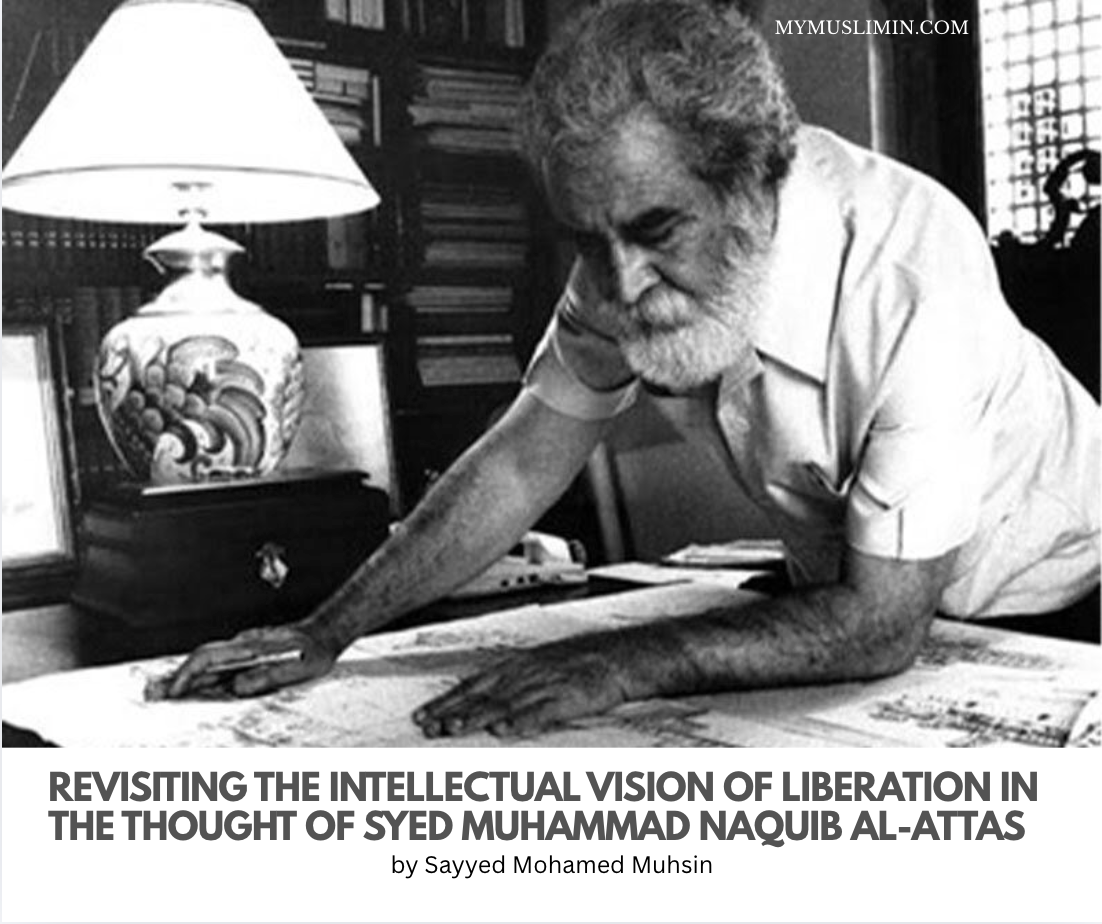
Royal Professor Syed Muhammad Naquib al-Attas (1931-2026) left behind a profound intellectual legacy and a lasting contribution to the discourse on the Islamization of Knowledge. He was among the most influential voices in articulating this vision and developing its philosophical foundations. His thought emphasized that the revival of Islamic civilization must begin with the reform of knowledge itself, because knowledge shapes worldview, ethics, and ultimately the structure of society.
Al-Attas argued that the Islamization of knowledge should begin by liberating human understanding from elements that distort the Islamic worldview. In this sense, the project is essentially a process of intellectual liberation. This can be understood in light of his well-known definition of Islamization as “the liberation of man first from magical, mythological, animistic, and national-cultural traditions, and then from secular control over his reason and his language.”
Over the past several decades, the discourse on Islamization has stimulated extensive debate within Muslim intellectual circles concerning the nature of knowledge, the crisis of modern education, and the need for a renewed Islamic intellectual framework.
The intellectual background of this discourse is closely connected to the historical experience of Muslim societies under colonial rule. Colonial powers realized that Muslim communities possessed a unique source of strength rooted in their unwavering faith, strong religious identity, and rich intellectual tradition. Consequently, colonial systems sought to weaken this strength by gradually distancing Muslims from their religious worldview and intellectual heritage. Through educational reforms, intellectual campaigns, and cultural influence, colonial structures introduced epistemological frameworks that reshaped how knowledge was produced, taught, and evaluated.
In response to this challenge, Muslim scholars and thinkers called for a reassessment of the foundations of modern knowledge. Within this context, the idea of the Islamization of Knowledge emerged as an intellectual response to the epistemological crisis facing Muslim societies.
A central concept in al-Attas’s intellectual project is the de-Westernization of present-day knowledge. According to him, knowledge is not neutral; rather, it is always shaped by the worldview, cultural assumptions, and philosophical orientation of the civilization that produces it. Modern Western knowledge therefore, carries within it the intellectual vision and psychological orientation of Western civilization. Al-Attas extended this critique to the structure of modern universities. In his view, the contemporary university often reflects an intellectual environment in which uncertainty, relativism, and conjecture are elevated as legitimate epistemological tools. He described the modern university as an institution that may perpetuate intellectual imbalance when knowledge becomes detached from its moral and spiritual foundations. This condition, in his terminology, represents a form of ẓulm—an injustice or disorder in the proper placement of knowledge.
For this reason, al-Attas insisted that the Islamization of Knowledge cannot be realized without first addressing the epistemological foundations of modern disciplines. De-westernization, therefore, becomes a necessary preliminary step. It involves critically examining the philosophical assumptions embedded within contemporary fields of knowledge and identifying elements that conflict with the Islamic worldview.
At the same time, it is important to emphasize that de-westernization does not imply rejecting modern knowledge altogether. Rather, the objective is to engage critically with contemporary disciplines and to integrate beneficial ideas, research methods, analytical tools, and scientific discoveries within a framework guided by Islamic principles.
He left us with a legacy whose relevance is as profound today as it was when he first articulated it, perhaps even more necessary in our present context. His vision calls for a renewed effort to rejuvenate this intellectual project and to translate it into meaningful change for the better.
This is not an exclusivist undertaking. While its immediate concern is the well-being and reform of the ummah, its benefits are not confined to Muslims alone. Once the intellectual and moral order of the ummah is restored, the positive impact naturally extends to the wider human community and, ultimately, to the well-being of humanity and the planet as a whole.
About the writer: Assoc. Prof. Dr. Sayyed Mohamed Muhsin is an Associate Professor of Islamic Jurisprudence at the International Islamic University Malaysia (IIUM).
Source: IIUM Today
 mymuslimin.com
Leave a comment